
- Commercial Greenhouse
- Film Greenhouse
- PC Greenhouse
- Glass Greenhouse
- Tunnel Greenhouse
- Scientific Research Greenhouse
- Vegetable Greenhouse
- Flower Greenhouse
- Multi-span Greenhouse
- Sawtooth Greenhouse
- Greenhouse Equipments
- Greenhouse Accessories
- Hot Dip Galvanized Pipe
- Irrigation System
- Hydroponics System
- Planting Tools
- Planting technology
Tel: +86 191 5068 3942
Fax:
Mobile: +86 191 5068 3942
Contact: Alina
E-mail: sales@cngreenhouses.com
SKYPE:

Carbon Dioxide in the Greenhouse: Supply and Control
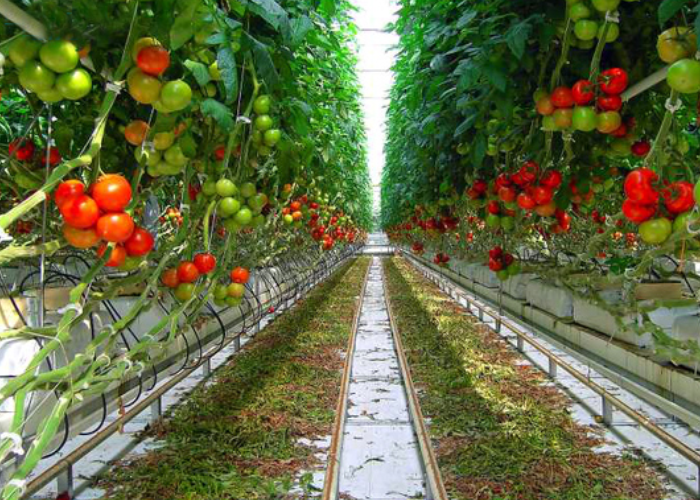
Once the vents shut, the crop inside a closed greenhouse can consume the carbon dioxide in the air faster than the structure lets it back in, and from that moment the gas becomes one of the limits on growth. The photos above show the crops this matters most to: dense beds of leafy greens and a fruiting tomato crop, both heavy users of carbon in full light. This page covers where the shortfall comes from, how it is made up, and what has to be measured and controlled before the level is raised.
Why carbon dioxide becomes the limiting factor
Carbon dioxide is the raw material of photosynthesis, alongside light and water. In the open field the air around the leaves is continually replaced, so supply is never the grower's problem. In a closed greenhouse it is: on a bright morning a dense canopy draws carbon dioxide out of the air inside faster than the gaps in the structure let it back in, and the concentration around the leaves falls below the level outside.
When it falls far enough, photosynthesis slows even though light, water and nutrients are all in place. The crop looks healthy and simply grows more slowly than it could, which is why the shortfall is easy to miss. At night the process reverses: respiration releases carbon dioxide back into the house, so the low point of the day is normally reached at the end of a long bright morning rather than during the night.
What closes the gap: ventilation, enrichment or both
There are two ways to bring the level back up, and most commercial houses use both. The first is ventilation: opening the house exchanges depleted air for outside air and restores the level to the outdoor background, at the same time as it removes heat and moisture. Ventilation is therefore the least costly form of enrichment, and a ventilated house rarely runs short.
The second is to add carbon dioxide deliberately, which is the only way to hold a level above the outdoor background. The choice between them depends on what else the house needs at that moment. In cold weather, opening the vents to gain carbon dioxide costs heat that has already been paid for, so the balance tips towards enrichment. In mild weather the vents may supply enough on their own, at no running cost.
Burner based supply, and what it demands
The most common way to add carbon dioxide in a heated house is to burn a clean fuel inside the structure. A burner designed for the purpose produces carbon dioxide and heat together, and in a heated greenhouse that heat is useful rather than wasted. For a house already burning coal or gas for warmth, the flue gas becomes a resource instead of a loss, provided combustion is complete.
Complete combustion is the condition that cannot be skipped. If a burner is badly set, under-fuelled or fed an unclean fuel, it produces carbon monoxide and other gases that damage the crop, and sulphur in the fuel is a problem both for the plants and for the metalwork above them. Burners used this way are run with an analyser, cleaned on a schedule, and never treated as a stopgap.
Distribution matters as much as generation. Carbon dioxide is heavier than air and will settle if it is released in one place, so the gas is usually spread along the house by the same ducting or fan system that moves heated air, with the release points placed above the canopy rather than at the ridge. How the other part of the air balance is managed is described under greenhouse humidity and dew point control.
Pure carbon dioxide sources and distribution
The alternative is to bring carbon dioxide in as a gas, either in cylinders or as a bulk liquid supply with a vaporiser, and release it through a pipe run along the crop. This route adds no heat and no combustion products, so the level can be raised regardless of the heating system and without any fuel risk inside the house.
In exchange it has to be bought and delivered, which suits smaller areas, trials, and houses without a burner. As with a burner, it is released above the crop and stirred into the house, and the same control rules apply: release only while the crop can use it, and stop when the vents are open.
Measurement, control and safety
Whichever source is used, the level is only controllable if it is measured. The sensor belongs in the crop layer, where the leaves actually are, not at the ridge where the gas collects, and it should read the same air the canopy sees. One sensor gives a house-wide reading; a second at the far end shows whether the distribution is working.
Carbon dioxide is used rather than stored, so the control logic follows the light: enrichment runs while the crop is photosynthesising and stops at night, when there is nothing to absorb it. It also follows the vents, because opening them both supplies free gas and throws added gas away. In practice the sequence is that enrichment runs while the house is closed, and ventilation takes over when the house has to be opened for temperature or humidity.
The safety side concerns people rather than plants. Carbon dioxide is not toxic at enrichment levels, but it displaces oxygen, and a leak from a bulk supply or a badly adjusted burner can fill a working area with gas that will not support breathing. Enrichment is therefore fitted with an alarm, bulk stores are kept outside the working area, and the house is ventilated before entry.
To have a carbon dioxide strategy reviewed alongside the ventilation and heating design, write to sales@cngreenhouses.com or call +86 191 5068 3942. With above 35 years in greenhouse engineering we cover the environmental side of a project from greenhouse growing technology through to the equipment itself, including how a house is ventilated in ventilation control and how heat is kept in under heat preservation design.
Independent background on controlled environment growing is published by the NGMA, and current commercial reporting by HortWeek.
Frequently Asked Questions about carbon dioxide in a greenhouse
Q1: Why does a closed greenhouse run short of carbon dioxide?
Because the crop uses it faster than the structure replaces it. In a sealed house the canopy draws carbon dioxide out of the air during the day, and the concentration around the leaves drops below the outside level, slowing photosynthesis even when light and water are sufficient.
Q2: Is opening the vents enough on its own?
Often yes, in mild weather. Ventilation restores the level to the outdoor background and removes heat and moisture at the same time. It cannot hold a level above the outdoor background, however, and in cold weather the heat lost through open vents usually costs more than deliberate enrichment would.
Q3: What has to be watched when a burner is used to supply carbon dioxide?
Combustion quality above all. An incorrectly set, under-fuelled or unclean burner produces carbon monoxide and other gases that harm the crop, and sulphur in the fuel damages both plants and the metalwork above them, so the burner is run with an analyser and cleaned on a schedule.
Q4: Where should the carbon dioxide sensor be placed?
In the crop layer, at the height where the leaves are. Carbon dioxide is heavier than air and tends to collect near the ridge, so a sensor mounted high reads a level the canopy never sees and the control system responds to the wrong number.
Q5: When should enrichment be switched off?
At night, and whenever the vents open. There is no photosynthesis to absorb the gas in darkness, and an open vent throws added gas straight out of the house. Most installations therefore run enrichment only while the house is closed and the crop has light.
Q6: Is added carbon dioxide a risk to the people working in the house?
Not at the levels used for enrichment, but it displaces oxygen, so a leak from a bulk supply or a badly adjusted burner can make an enclosed working area unsafe. Enrichment systems are fitted with an alarm, bulk stores are kept outside the working area, and the house is ventilated before entry after enrichment.
 Deutsch
 Español
 Français
 Italiano
 Português
 日本の
日本の
 한국어
한국어
 العربية
 български
 hrvatski
 česky
česky
 Dansk
Dansk
 Nederlands
 suomi
suomi
 Ελληνικά
 हिन्दी
 norsk
norsk
 Polski
 Română
 русский
 Svenska